Start with one or two focused SDC sessions per week.
If you train it twice, give the two sessions different jobs:
Session A builds speed, turns, and transitions.
Session B builds the drag, carry, and your ability to keep moving under load.
ArmyFitHub SDC Training at a Glance
Frequency
1–2 sessions per week
Speed day
Accelerations, turns, and transitions
Load day
Drag, carry, and one strength exercise
Hard rest
60–90 seconds for sprints; 90–120 for drags
Progression
Add quality repetitions only when speed and transitions hold
One-day option
Prioritize short speed work, then one loaded block
Train the parts that lose time without turning every day into a full test.
ArmyFitHub weekly plan: use one speed-and-transition session and one loaded-work session when your schedule allows.
Session A — Speed and Transitions
Start with:
25-Meter Accelerations — 4–6 reps
Accelerate hard, then take enough recovery to make the next rep fast.
Walk back and rest about 60–90 seconds.
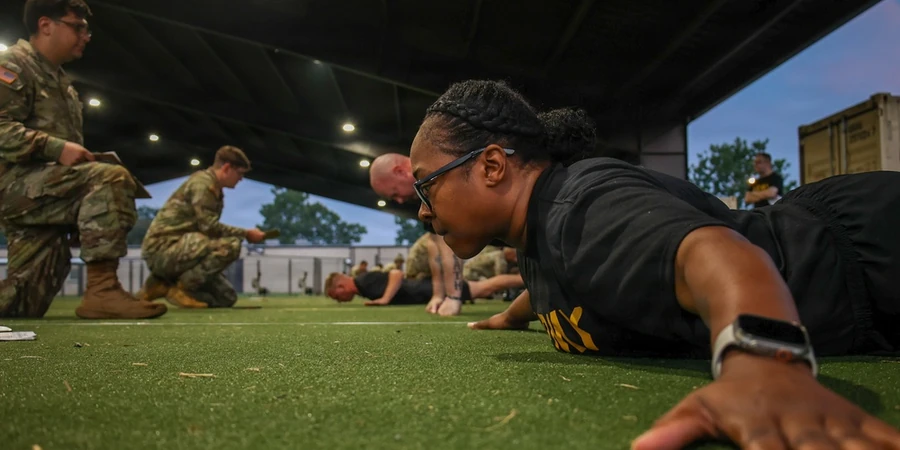
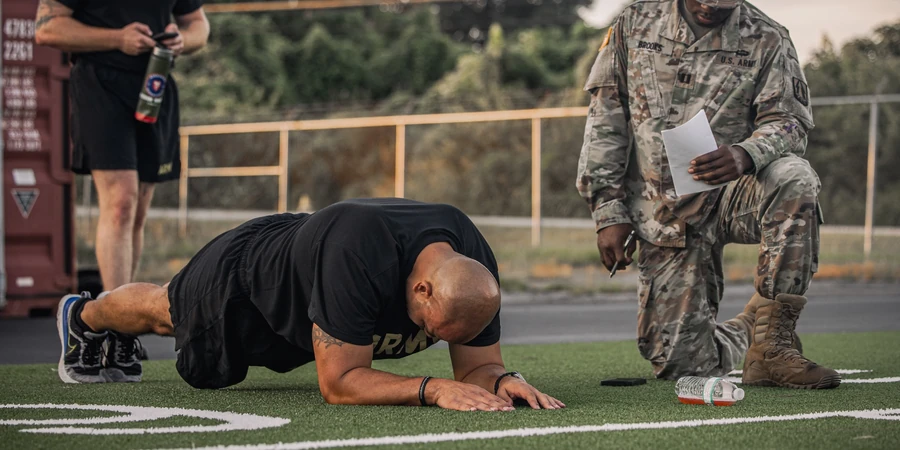
Use a few Prone-Start Accelerations within that set when possible. Start
prone, get up cleanly, and enter the acceleration without wasting steps.
Then practice:
25-Meter Transition Shuttle — 3–4 reps
Run out, make a clean line touch and turn, then accelerate back. Practice the
last few meters before the line, the turn, and the first few meters after it as
one linked action.
The Army-listed 300M Shuttle Run appears in the Official Army Training section below. Use the official SDC event reference for the current scored sequence.
Rest 2–3 minutes between hard shuttles.
Keep the official line actions in the work: sprint and lateral segments use
the required foot-and-hand touch without crossing the line during the lateral; the sled must cross the line fully; the
carry reaches the turn line and crosses the start line before the implements
are placed down; and the final sprint finishes with the required crossing.
Use the current ATP 7-22.01 testing guidance for the full standard.
Finish with:
Transition Practice — 4–6 short repetitions
Rehearse only the changes between movements:
sprint to sled;
sled to lateral;
lateral to kettlebells;
kettlebells to final sprint.
Keep this work to the movement changes so the next segment starts without extra repositioning or steps.
Session B — Drag and Carry
Start with:
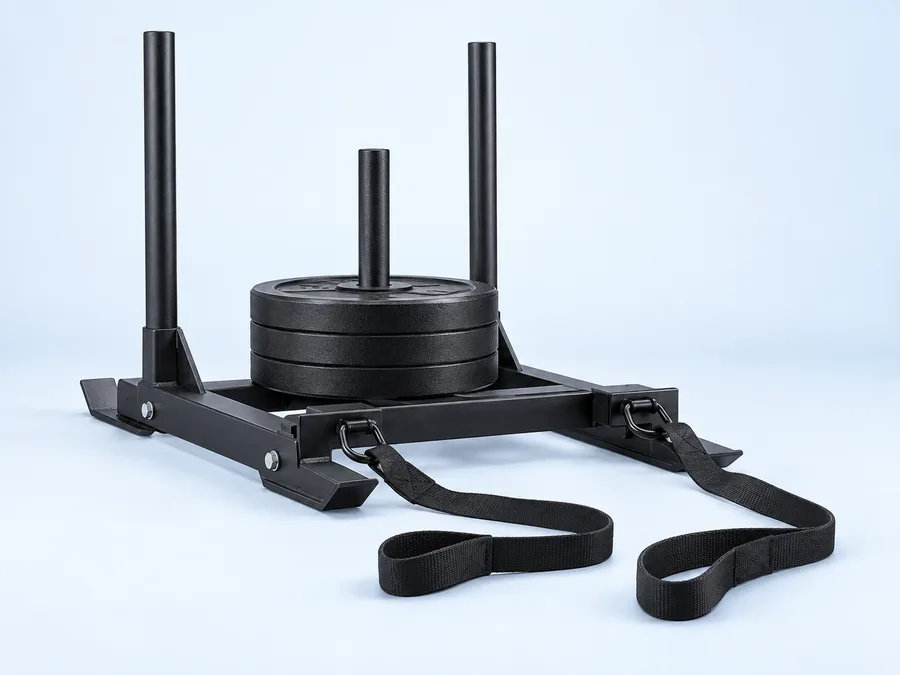
Backward Sled Drag — 4 × 25 meters
Rest 90–120 seconds between reps.
When AFT setup is available, use the 90-pound test sled for test-specific practice. The current test load and sequence come from ATP 7-22.01.
Sled resistance changes with the sled and surface, so match test setup as closely as practical. Keep strap tension controlled through the pull and redirect; do not sling or whip the straps to turn the sled.
Use short, quick backward steps and keep the pull continuous. Keep the drag fast enough to remain SDC-specific; use separate strength work for heavier loading.
Then:
Kettlebell Carry — 3–4 × 50 meters
For test-specific carry practice, use two 40-pound kettlebells.
Move as quickly as you can control while keeping both kettlebells stable.
Pick up both kettlebells under control, stabilize them before moving, turn
under control, and place them down only after the required crossing. Do not
drop or swing the implements into the next transition.
Rest enough that grip and posture do not fall apart from one repeat to the next.
Then choose one Army-listed strength exercise:
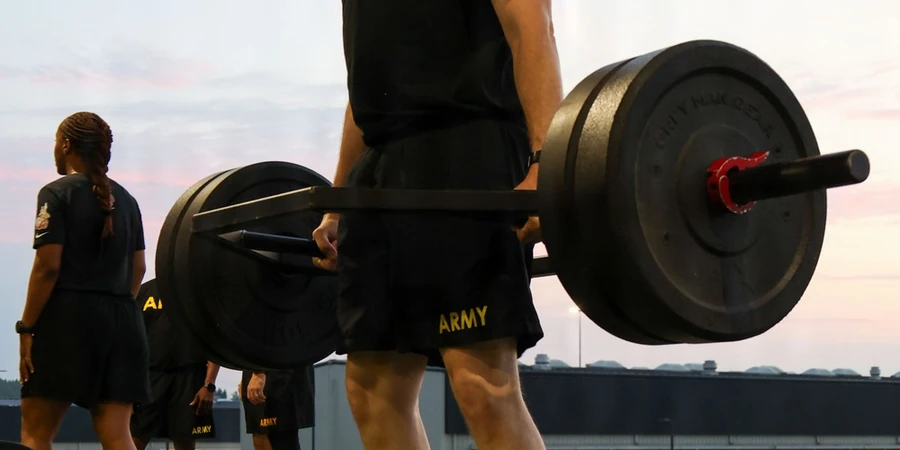
Straight Leg Deadlift — 3 working sets
or
Bent Over Row — 3 working sets
Use a weight you can control through every repetition.
The support work comes after the event-specific work.
How to Pace the SDC
Use full-event practice to judge the opening sprint. Judge pacing by total time and how well speed carries through the drag, carry, and final sprint.
If an aggressive first shuttle repeatedly slows the drag or later segments, reduce the opening effort slightly. If the drag remains strong, keep the speed; save effort only when the downstream segments show a repeated drop-off.
How to Progress Your SDC
Progress one part of the event at a time.
Your sprint and turns stay sharp
→ Add another high-quality repetition.
Your drag stays fast and controlled
→ Add a little work or gradually increase resistance during training.
Your carry stays stable
→ Increase speed before adding unnecessary extra distance.
Your last repeat is much slower than your first
→ Keep the same workload until the repeats become more consistent.
Your transitions are still messy
→ Fix them before adding more conditioning.
A cleaner turn that removes two unnecessary steps is progression too.
Why Train the SDC This Way?
The SDC combines sprinting, loaded dragging, lateral movement, carrying, and repeated acceleration across five 50-meter shuttles. Confirm the current test setup in ATP 7-22.01.
The Army classifies it across muscular endurance, muscular strength, anaerobic power, and anaerobic endurance in U.S. Army AFT guidance. Training therefore separates speed and transition work, loaded event practice, and supporting strength.
The Army-listed 300M Shuttle Run, Straight Leg Deadlift, and Bent Over Row appear in the U.S. Army AFT event guidance. Place that strength work after SDC-specific work.
If You Only Have One SDC Day Per Week
Use this sequence:
Acceleration, including prone starts — 4 reps
Then:
Linked transition / shuttle practice — 3 clean reps
Then:
Backward Sled Drag — 3 × 25 meters
Then:
Kettlebell Carry — 3 × 50 meters
Finish with:
One controlled full SDC if the preceding work is still sharp
Add a second only if speed and transitions remain clean. Add one Army-listed support exercise only while the event-specific work still has quality.
If You Are New to the SDC
Learn the sequence first.
Sprint → Drag → Lateral → Carry → Sprint.
Walk through Sprint → Drag → Lateral → Carry → Sprint until the sequence, equipment positions, and transitions are automatic. Then add speed.
How to Improve Your SDC Time
Break the final time into the first sprint, drag, lateral, carry, transitions, and final sprint.
If the drag is slow: use short backward sled intervals while you are fresh enough to produce force. Keep the steps short and continuous. Keep actual sled-drag practice in the program while using the Army-listed Straight Leg Deadlift for additional posterior-chain strength.
If the carry is the weak point: note what changes first—grip, posture, foot speed, or overall pace. Use shorter controlled carries before adding distance, then build speed with two 40-pound kettlebells.
If turns or transitions lose time: set a 25-meter line and rehearse approach, touch, plant, turn, and acceleration without running the full event. The Army-listed 300M Shuttle Run adds repeated acceleration and direction-change work. Use FM 7-22 for broader speed, strength, and conditioning principles.
If the final sprint falls apart: review the drag, carry, and transitions. If one segment slows markedly first, improve that segment and your ability to recover between hard efforts before adding more final-sprint work.
How to Train the SDC Without a Full Test Setup
Use short accelerations, prone-start practice where possible, 25-meter linked
shuttles, direction changes, loaded carries, Straight Leg Deadlifts, and Bent
Over Rows. A drag substitute can train backward loaded movement; resistance will
vary with the implement and surface. Get some practice with a 90-pound sled
and two 40-pound kettlebells before test day when available.
How Often Should You Run a Full SDC?
Use a full SDC periodically to check total time, transitions, pace drop, and the final sprint. Use the result to choose the next training priority.
Practice the Actual Test Setup
Before test day, practice the 25-meter lane, 90-pound sled, two 40-pound kettlebells, strap setup, carry pickup, and final transition in the arrangement you expect to use.
The Week Before Your AFT
Reduce hard sled and full-event volume during the final week. Keep one short early-week session with accelerations, turns, a brief drag, carry, and transitions. Finish fresh.
SDC is event three; PLK and 2MR still follow.
Common SDC Training Mistakes
Running the full SDC every workout. Full attempts are useful tests, but partial work gives you more chances to improve the weak section.
Opening too aggressively. A fast first shuttle is a problem when the drag or later segments repeatedly slow down.
Ignoring the turns. Extra steps and poor line approaches cost time without making you fitter.
Only training straight-line speed. The SDC includes braking, direction changes, loaded movement, and transitions.
Progressing only by adding sled resistance. Keep the drag fast and controlled before increasing load.
Never practicing the actual equipment. Sled friction, straps, kettlebell handling, and transitions all feel different from ordinary gym exercises.
Doing heavy leg work too close to SDC practice. If your legs are already exhausted, the session becomes a fatigue test instead of useful speed work.
SDC Training Questions
Do I need to run a full SDC every week?
Use partial sprint, transition, drag, and carry work to improve the section that loses time, then use a full attempt later to check total time and transfer.
Should I keep making the sled heavier?
Keep the test load specific when possible and change resistance only when speed, posture, and control remain consistent; sled resistance varies by surface and design.
What if I only have one SDC day?
Use four accelerations, three clean linked transition or shuttle repetitions, three 25-meter drags, and three 50-meter carries. Finish with one controlled full SDC if quality remains; add a second only if speed and transitions stay clean.
How can I train the SDC without a sled?
Use short accelerations, prone starts, 25-meter transitions, direction changes, loaded carries, and Army-listed strength work. A drag substitute can train backward loaded movement while resistance varies by implement and surface.
How should I prepare during test week?
Reduce hard sled and full-event volume during the final week. Keep one short early-week session with accelerations, turns, transitions, a brief drag, and a brief carry. SDC is event three; protect the legs you need for the PLK and 2MR.
Personalized AFT Plan
Build a complete 5-event AFT training plan
Start with your AFT assessment, then get a personalized AFT training plan PDF created from your scores, target, training availability, equipment, and test timing.
The PDF covers all five AFT events, with SDC included as training context.
Your personalized plan uses your five event scores, schedule, and equipment to place SDC work around MDL and 2MR without stacking the hardest lower-body sessions together.
Start My AFT Plan $24.99 one-time · Reviewed before PDF delivery · Secure PDF by email · Delivered within 24 hours after Plan Setup
The Army describes the Straight Leg Deadlift as a posterior-chain exercise for the lower back, hips, and legs. That strength and control support the SDC’s drag and carry work, where the Soldier must repeatedly hinge, pull, and move load without losing trunk position.
How to Perform the Straight Leg Deadlift
1Start in a straddle stance with the knees slightly flexed and held in the same position throughout the repetition.
2Hinge forward from the waist with the head aligned to the spine until the back is parallel to the ground.
3Pause briefly, then reverse the hinge to return to standing and repeat with a load you can control.
Key Cues for the Straight Leg Deadlift
Keep the knees soft rather than locked.
Keep the head aligned with the spine.
Use a controlled range and weight.
Common Mistakes in the Straight Leg Deadlift
Rounding or extending the neck as the trunk hinges.
Locking the knees or using a weight that cannot be controlled.
Army guidance identifies the Bent Over Row as a Strength Training Circuit exercise for the upper back, shoulder girdle, and biceps, with heavier loads also challenging the lower back, glutes, and hamstrings. That pulling and trunk endurance supports the SDC’s drag and carry segments.
How to Perform the Bent Over Row
1Set the forward leaning stance with the arms hanging in front of the legs and hold equal weights with a closed neutral grip.
2Pull by bending the elbows toward the chest while the legs, torso, and head stay in the starting position.
3Lower the weights under control and continue the prescribed work only while the movement remains to standard.
Key Cues for the Bent Over Row
Keep the torso and head still.
Pull the weights toward the chest, not by swinging the body.
Adjust the load when control or standard drops.
Common Mistakes in the Bent Over Row
Using the torso to create momentum instead of keeping it in the starting position.
Continuing after the selected weight can no longer be controlled to standard.
Army-listed repeated acceleration, deceleration, and direction-change exercise for SDC preparation.
Listed by the U.S. Army for SDC preparation.
Why the 300M Shuttle Run Helps the SDC
The Army lists the 300M Shuttle Run for SDC preparation. Repeated 25-meter out-and-back efforts train acceleration, deceleration, direction changes, and repeated-sprint ability.
How to Perform the 300M Shuttle Run
1Run each 25-meter shuttle to the turnaround line, slow before planting, and change direction under control.
2Bend and squat to touch the ground at the turn, alternating the appropriate hand on each turn as specified by the Army training guide.
3Complete the repeated out-and-back shuttles for 300 meters, accelerating after each turn and through the finish.
Key Cues for the 300M Shuttle Run
Lower the speed before the plant instead of carrying full speed into the turn.
Use the alternating hand touch and keep the head up to monitor the lane.
Accelerate immediately after the direction change without adding extra steps.
Common Mistakes in the 300M Shuttle Run
Planting at full speed and losing time during the turn.
Reaching without bending and squatting enough to make a controlled line touch.
Failing to alternate the hand touch or lowering the head while changing direction.