
Approved tape
Use a non-stretchable tape, preferably fiberglass. The Army procedure says cloth and steel tapes are unacceptable; the tape must be narrow enough to conform to the body and at least five feet long.
Follow EXORD 182-26 Annex A for height, waist placement, recording increments, repeated measurements, and the additional-measurement rule. DA Form 5500 records the selected waist average and WHtR.
Before measuring
Use a non-stretchable tape, preferably fiberglass. The Army procedure says cloth and steel tapes are unacceptable; the tape must be narrow enough to conform to the body and at least five feet long.
Use a flat surface and measure in socks without shoes. A trained team records the result on the Army worksheet.
Measurements for male and female Soldiers are recorded on DA Form 5500, with the WHtR result entered using the current recording precision.
Step 1
Stand in socks without shoes on a flat surface. Keep the body straight but not rigid, with the head horizontal, eyes forward, and chin parallel to the floor. Record height to the nearest half inch.
Step 2
Measure at the navel (belly button), with the tape beginning on the Soldier’s right side and staying horizontal and parallel to the floor. The tape should contact the skin and conform to the body without compressing soft tissue.
Keep arms naturally at the sides. Measurement clothing must follow the current Army procedure; binding undergarments are not authorized.
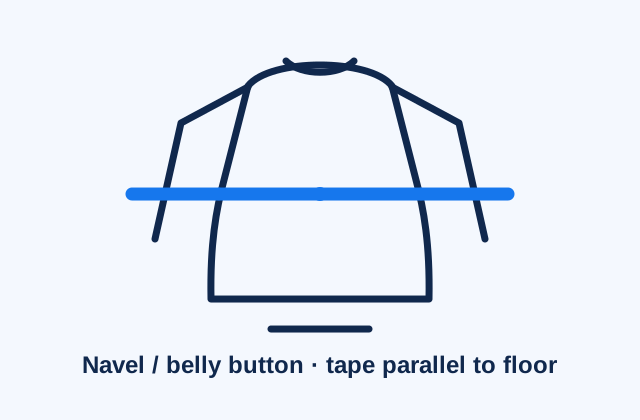
Navel / belly button
Keep the tape parallel to the floor.If a skin fold obscures the navel, identify the direct location on the outer fold and measure across that mark. If no navel is anatomically present, use the Army procedure’s alternative landmark: the hip bone, marked two inches above.
Steps 3–4
Complete three waist circumference measurements for every Soldier.
Round waist down to the nearest half inch before it is recorded.
Compare the three recorded readings before calculating the average.
When readings differ
If one of the first three recorded measurements differs from the other two by more than 1 inch, take an additional measurement. Use the three measurements with the least difference to calculate the mathematical average.
Do not average inconsistent readings before completing the additional measurement.Final calculation
Measurement team
Two trained members take part: one places the tape and determines the measurement, while the other checks placement and tension and records the result on DA Form 5500. Same-sex trained personnel are used when available; if not, the observation safeguards in the current Army procedure apply. Soldiers are measured in socks and the standard Army physical fitness uniform, without binding undergarments.
Common questions
ArmyFitHub accepts centimeters as a convenience input, converts them to inches, and applies the Army inch recording increments. The official form records inches.
It should contact and follow the body without compressing soft tissue.
A different measurement team completes confirmation on the same duty day before commander action.
If one recorded measurement differs from both of the other two by more than 1 inch, take a fourth measurement and use the three readings with the least difference.
Official references
These Army publications define the current WHtR standard, measurement procedure, worksheet, and implementation status.
Last verified Sep 28, 2026.